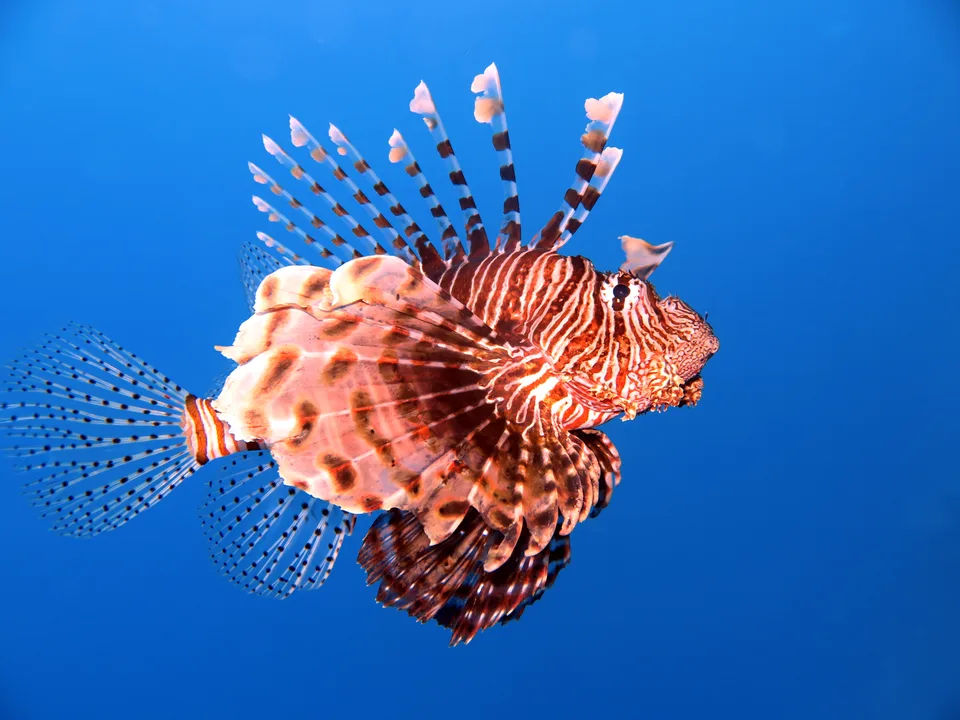
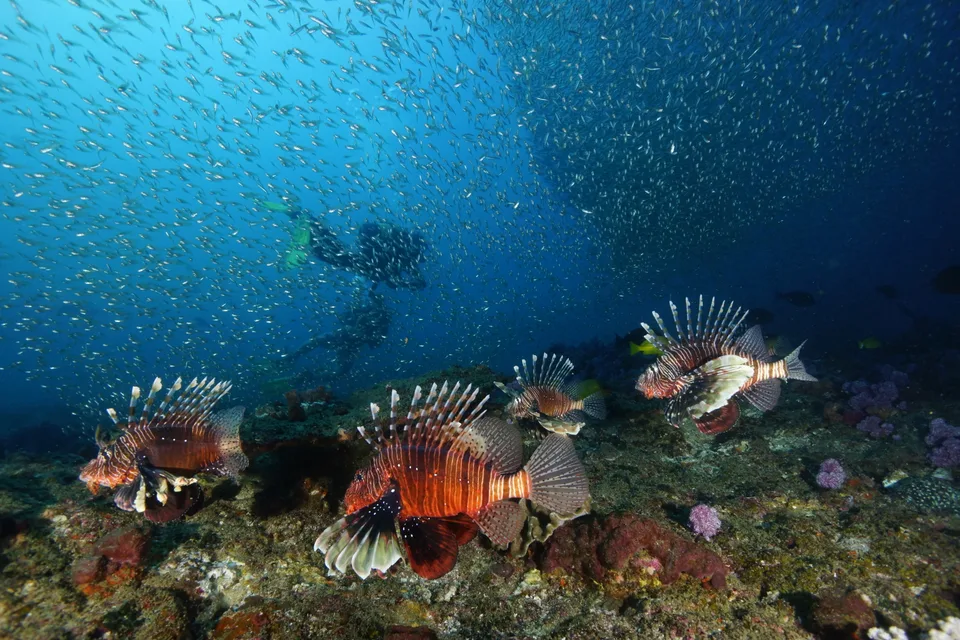
Coral reefs and rocky substrates in shallow waters.
Distribution
Native to the Red Sea and the Indian Ocean, now also found in the Western Atlantic.
Conservation status
Least Concern
Edibility
Edible and regarded as palatable when properly prepared, but the venomous dorsal, anal and pelvic spines must be handled and removed with great care. Do not eat fish that are not safely identified or properly prepared.
Culinary quality / 5
3
Danger level
Dangerous
Usual observation depth
1–30 m
Behaviour
Generally solitary or in small loose groups. Primarily crepuscular and nocturnal, it remains sheltered during the day and actively hunts at dusk and at night. It is an ambush predator that uses its broad pectoral fins to corner its prey.
Observation zones
Coral reef, rocky reef, reef wall, lagoon, sheltered bay, rubble slope, artificial reef, jetty and wreck; often under overhangs or in crevices.
Diet
Primarily small reef fish, but also crustaceans such as shrimp and crabs. It can swallow prey representing a significant proportion of its own length.
Reproduction
Oviparous
Identification marks
Marked red, brown and white vertical bands; very long, separate venomous dorsal spines; fan-shaped pectoral fins with ringed rays; and fleshy tentacles above the eyes and around the mouth. Adults generally reach about 35 cm.
Similar species
Most often confused with the red lionfish, Pterois volitans. The two species are very similar in color and body shape; reliable identification generally requires counting the fin rays: P. miles typically has 10 soft dorsal rays and usually 17 pectoral rays, compared with usually 11 and 18 in P. volitans. Hybrids occur in some invaded areas.
Approach rules
Observe calmly without touching or cornering the fish. Keep hands, fins and equipment well away from all spines; maintain at least 1 m distance when conditions permit. Avoid using flash at very close range, never feed it and do not attempt to handle or spear it without appropriate training and protective equipment.
Protection
Classified as “Least Concern” (LC) by the IUCN. It is not listed under CITES. In some parts of the Mediterranean, it is an invasive alien species; management measures should follow the recommendations of the competent authorities.