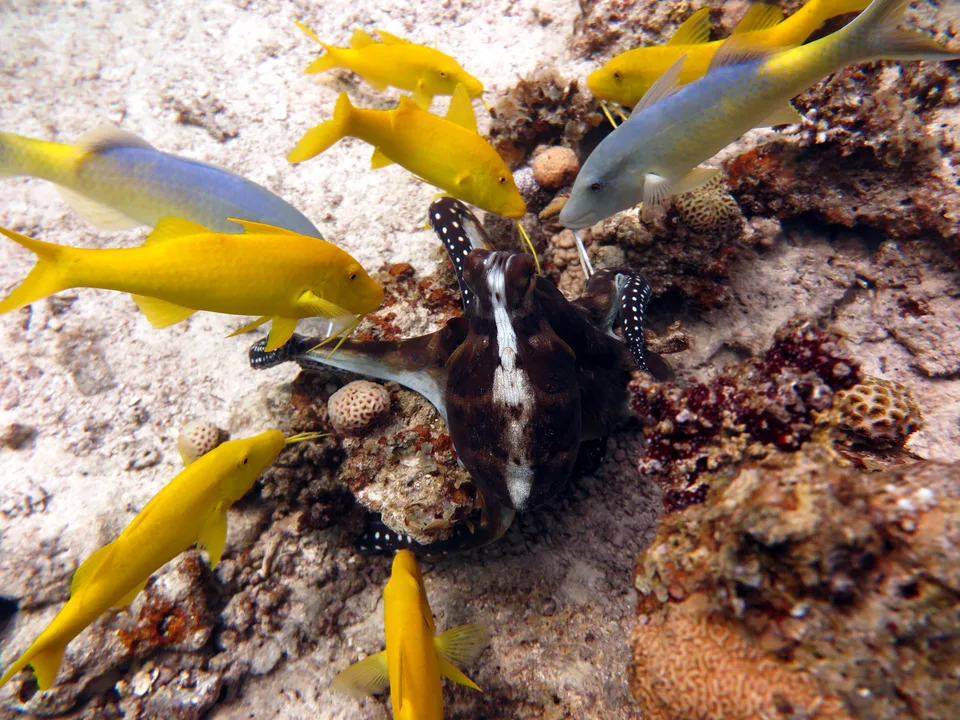
Coral reefs and rocky substrates in shallow waters
Distribution
Tropical and subtropical waters of the Indo-Pacific region
Conservation status
Least Concern
Edibility
Edible and widely consumed in parts of its range. Prepare and cook thoroughly; obtain only from responsible, traceable sources and follow relevant health advice.
Culinary quality / 5
4
Danger level
Caution
Usual observation depth
1–30 m
Behaviour
Generally solitary and highly territorial around its den. Unlike many octopuses, it is primarily diurnal, actively hunts during the day, and uses rapid changes in color, patterns, and skin texture for camouflage and communication.
Observation zones
Shallow coral reefs, reef flats, lagoons, rocky crevices, coral rubble and adjacent sand; sometimes on reef slopes.
Diet
Active predator feeding mainly on crabs and other crustaceans, but also on bivalves, gastropods, fish, and other small reef animals.
Reproduction
Oviparous
Identification marks
Large octopus with long arms, with highly variable coloration and texture. It often displays bright iridescent blue spots or ocelli and contrasting dark markings when disturbed or during courtship; it is frequently observed moving actively across the reef in broad daylight.
Similar species
May be confused with other large Octopus species of the Indo-Pacific, particularly the common octopus complex. Its mainly diurnal activity, shallow reef habitat, large size, and iridescent blue spots when displaying are useful clues, but identification may require regional expertise because the patterns change rapidly.
Approach rules
Observe calmly from at least 2 to 3 m away. Do not touch, corner, handle, or obstruct its den; leave it an escape route. Avoid repeated flashes and never feed it. A bite is possible if it is handled.
Protection
IUCN : Least Concern (LC). The species is not listed in the CITES appendices. Protection, collection limits and trade controls may vary by location; check applicable local regulations.