Edible and used as food in parts of its range. Handle carefully because the dorsal spines may cause painful injuries; follow local seafood safety advice.
Culinary quality / 5
3
Danger level
Caution
Usual observation depth
5–25 m
Behaviour
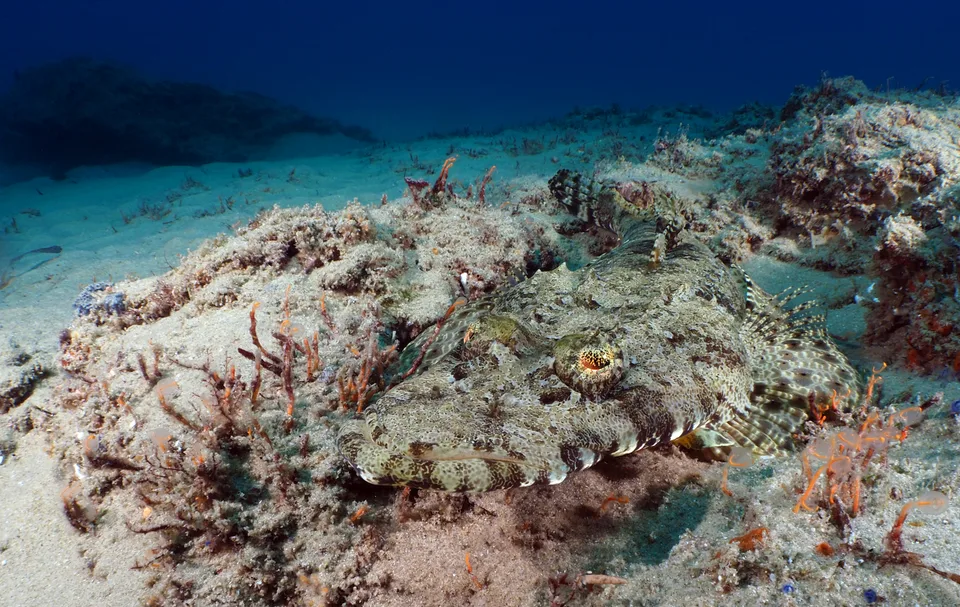
Generally solitary, sedentary, and very well camouflaged on the bottom. It is an ambush predator that remains motionless before striking at nearby prey; it may be more active at night.
Observation zones
Sand, mud, debris, seagrass bed edges, sheltered reef flats and reef bases.
Diet
Primarily small bottom-dwelling fish and crustaceans, as well as other small benthic animals captured opportunistically.
Reproduction
Oviparous
Identification marks
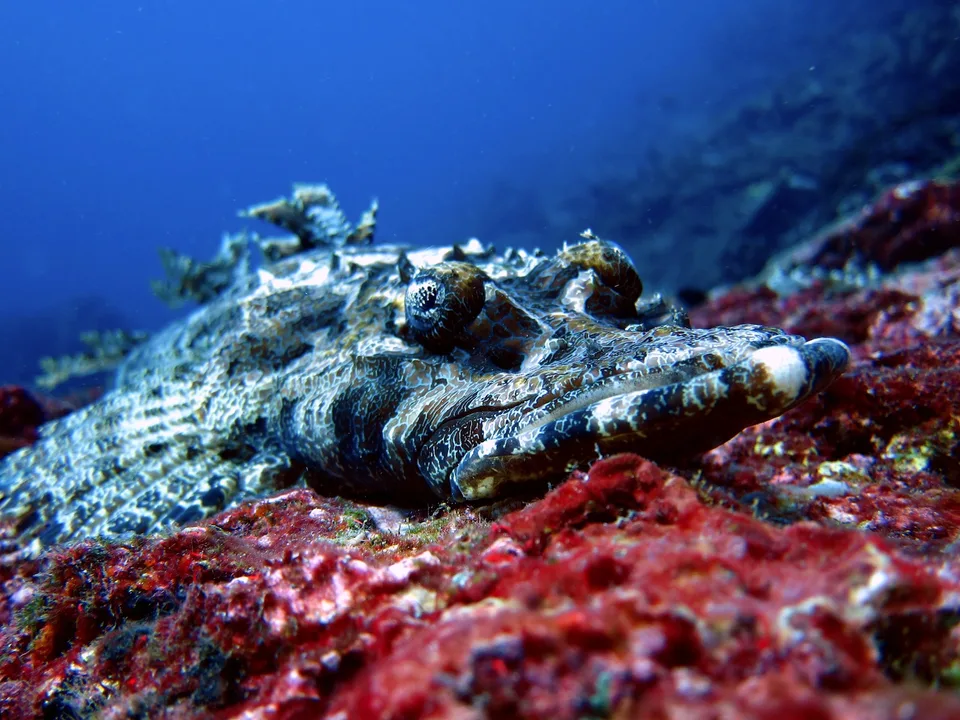
Large flattened fish with a broad head, with both eyes located on top of the head. It has fleshy tentacles and characteristic skin flaps around the eyes and snout, a wide mouth, and camouflaged brown-and-cream coloration.
Similar species
It may be confused with other flatheads, notably species of the genus Platycephalus. The highly visible tentacles and skin flaps around the eyes and snout, together with its very broad head, distinguish it from most other regional flatheads.
Approach rules
Approach slowly and remain at a distance from the head and dorsal fin. Do not touch, pursue, feed, or intentionally uncover the animal from the substrate. Avoid using flash at very close range and leave it enough space to remain camouflaged.
Protection
Globally assessed as “Least Concern” on the IUCN Red List. It is not listed in the CITES appendices. General recommendation: avoid unnecessary disturbances and support sustainable fisheries management.