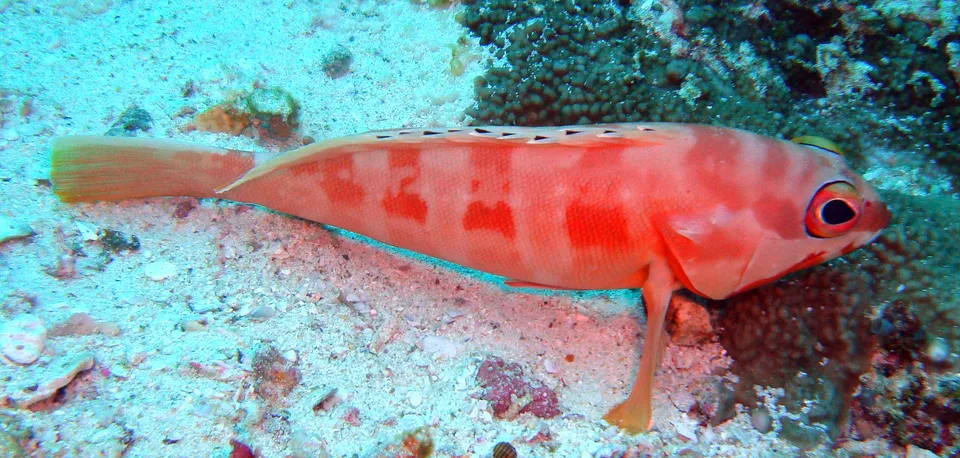
Found in the tropical and subtropical waters of the Indo-Pacific region.
Conservation status
Least Concern
Edibility
Edible and locally marketed fresh or dried/salted. Consume only from safe, traceable sources; reef fish may present ciguatera risk in some areas.
Culinary quality / 5
3
Danger level
Harmless
Usual observation depth
20–100 m
Behaviour
Primarily nocturnal. Generally rests during the day in caves, crevices or under overhangs, alone or in small groups, then emerges at night to feed.
Observation zones
Reef slopes, deep reefs, caves, overhangs, ledges and rocky reefs.
Diet
Nocturnal predator feeding mainly on small fish, crustaceans, and other zooplanktonic or benthic invertebrates.
Reproduction
Oviparous
Identification marks
Red to orange-red bigeye, with exceptionally large eyes, a deep and compressed body, long dorsal spines, and a distinctly crescent-shaped caudal fin with pointed lobes.
Similar species
May be confused with other bigeyes of the genus Priacanthus, notably the purple-spotted bigeye (Priacanthus tayenus) and Paxton's bigeye (Priacanthus blochii). The distinctly lunate, crescent-shaped caudal fin is an important characteristic of Priacanthus hamrur; confirm with regional guides.
Approach rules
Approach slowly and quietly without blocking its shelter or exit. Keep a respectful distance, do not touch or chase the animal, limit lighting and avoid repeated flashes; never feed it.
Protection
Globally assessed as « Least Concern » on the IUCN Red List. The species is not listed under CITES. Adopt responsible reef fish observation and seafood sourcing practices.