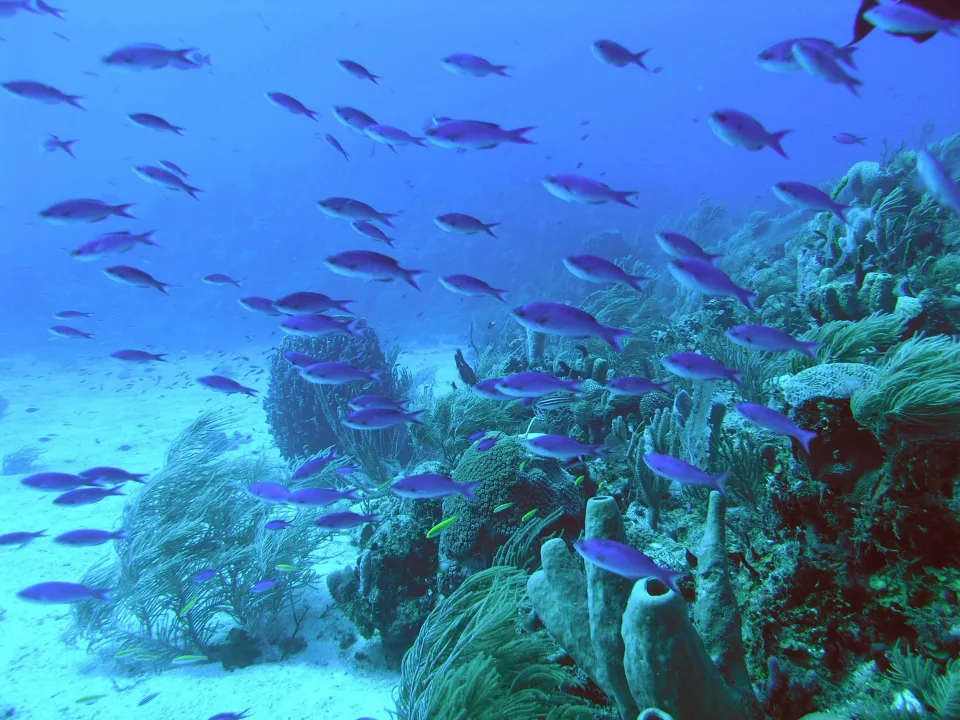
Clear tropical marine waters around coral and rocky reefs, especially outer reef slopes, drop-offs and reef edges with strong currents.
Distribution
Tropical western Atlantic, including Bermuda, southern Florida, the Bahamas, the Caribbean Sea and adjacent coasts of northern South America.
Conservation status
Least Concern
Edibility
Edible and occasionally sold fresh, but reef fish can carry ciguatera toxins in some areas. Consume only from reliable sources and follow local health advisories.
Culinary quality / 5
3
Danger level
Harmless
Usual observation depth
10–30 m
Lifespan (years)
0
Behaviour
A diurnal, highly social wrasse that commonly forms large, active schools in mid-water above reefs. Schools feed in the current and may shelter close to the reef.
Observation zones
Outer reef slopes, reef walls, drop-offs, current-swept reef edges and adjacent blue water.
Diet
Primarily zooplankton and other small drifting invertebrates captured in the water column.
Reproduction
Oviparous
Identification marks
Slender, laterally compressed wrasse with a pointed snout; adults are predominantly blue to violet, with conspicuous yellow on the upper body and fins. Usually seen in large schools above reef slopes.
Similar species
May be confused with other Clepticus wrasses, especially the Brazilian wrasse (Clepticus brasiliensis). Geographic range is useful: C. parrae occurs in the Caribbean and western Atlantic north of Brazil, whereas C. brasiliensis is associated with Brazil. Its large planktivorous schools and blue-violet and yellow adult coloration also help identify it.
Approach rules
Approach slowly and parallel to the school without blocking its route or separating fish from the group. Keep a respectful distance of about 2–3 m, do not chase or feed fish, and use flash sparingly.
Protection
IUCN Least Concern (LC). Not listed in the CITES Appendices. No specific international trade restriction is indicated; follow applicable local conservation measures.