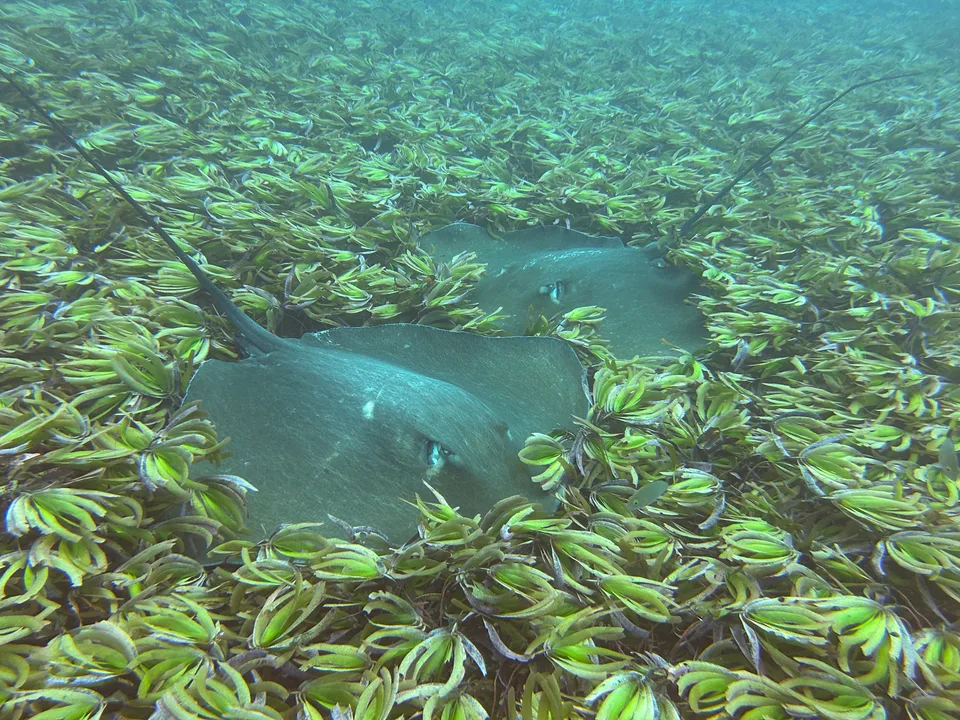
Shallow coastal waters, often found in sandy or muddy substrates.
Distribution
Found in the tropical and subtropical waters of the Indo-Pacific region.
Conservation status
Least Concern
Edibility
Edible and locally eaten, but consumption is not recommended because the species is threatened; handle only after removing the venomous tail spines.
Culinary quality / 5
3
Danger level
Caution
Usual observation depth
1–30 m
Lifespan (years)
12
Behaviour
Generally solitary or observed in small, loose groups. It lives mainly on the bottom and often partially covers itself with sediment; it can enter estuaries and mangroves. It defends itself with its venomous caudal spines if threatened.
Observation zones
Sand, mudflats, lagoons, shallow reefs, seagrass bed edges, estuaries and mangroves.
Diet
Feeds mainly on benthic invertebrates, notably crustaceans, mollusks and worms, as well as small bony fish.
Reproduction
Viviparous
Identification marks
Large grayish-brown ray with a rhomboidal disc, a broad tail base, and a long whip-like tail bearing venomous spines. The ventral surface is pale. It is one of the largest stingrays in the shallow waters of its range.
Similar species
It may be confused with other Indo-Pacific species of Pastinachus, especially the broad cowtail stingray (Pastinachus ater). External characteristics overlap and the taxonomy has been revised; reliable identification may require careful examination, locality data, or genetic confirmation.
Approach rules
Observe calmly from the side, keeping several metres away. Never touch, corner, or pursue a ray, and never position yourself above a potentially buried individual. Avoid using flash at close range and never feed it. Stay out of reach of its tail and venomous spines.
Protection
Classified as Vulnerable on the IUCN Red List. General conservation priorities include reducing bycatch, protecting coastal nursery habitats, and avoiding unnecessary capture or disturbance.