Coastal waters, often found in sandy or muddy substrates.
Distribution
Found in the tropical and subtropical waters of the Indo-Pacific region.
Conservation status
Least Concern
Edibility
Edible, but consumption is not recommended because this threatened ray is vulnerable to fishing pressure and bycatch. Do not consume specimens of uncertain origin or freshness.
Culinary quality / 5
2
Danger level
Caution
Usual observation depth
5–50 m
Behaviour
Generally solitary or in small groups. It swims near the bottom to feed and can form seasonal aggregations. It is usually shy and non-aggressive, but possesses a defensive venomous caudal spine.
Observation zones
Sand, mud, seagrass beds, lagoons, estuaries, sheltered bays, reef edges and shallow blue water on the continental shelf.
Diet
Mainly benthic invertebrates, notably bivalve molluscs, crustaceans and worms; it may also capture small fish.
Reproduction
Ovoviviparous
Identification marks
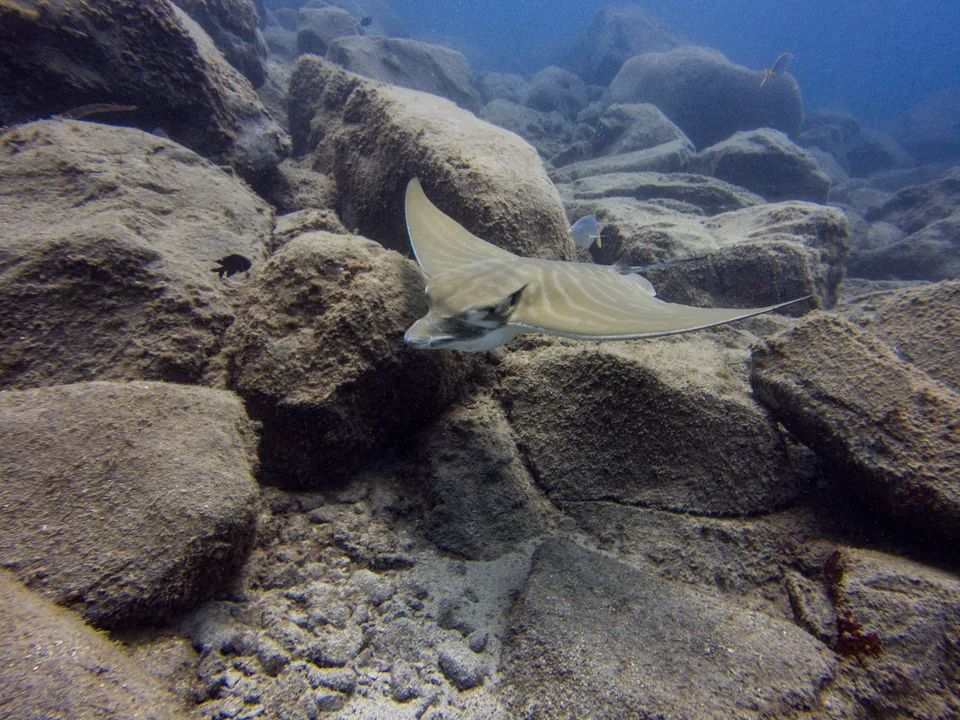
Very large robust eagle ray, with a broad rhomboid disc, distinctly protruding head, long whip-like tail and small dorsal fin near the base of the tail. The upper surface is grey-brown to dark brown, often marked with light spots, especially in juveniles.
Similar species
May be confused with other eagle rays, notably Myliobatis aquila and spotted eagle rays. The bull ray is distinctly larger and more robust, with a strongly protruding head reminiscent of that of a bull; spotted eagle rays generally have more regular and visible white spots.
Approach rules
Observe calmly from the side, maintaining at least 3 m of distance, without blocking its path or pursuing it. Do not touch the ray or its tail, do not use flash, and never feed it.
Protection
Listed as Critically Endangered on the IUCN Red List. General conservation priorities include preventing targeted and incidental captures, protecting coastal nursery areas, and reporting sightings to local monitoring programs. It is not listed under CITES.