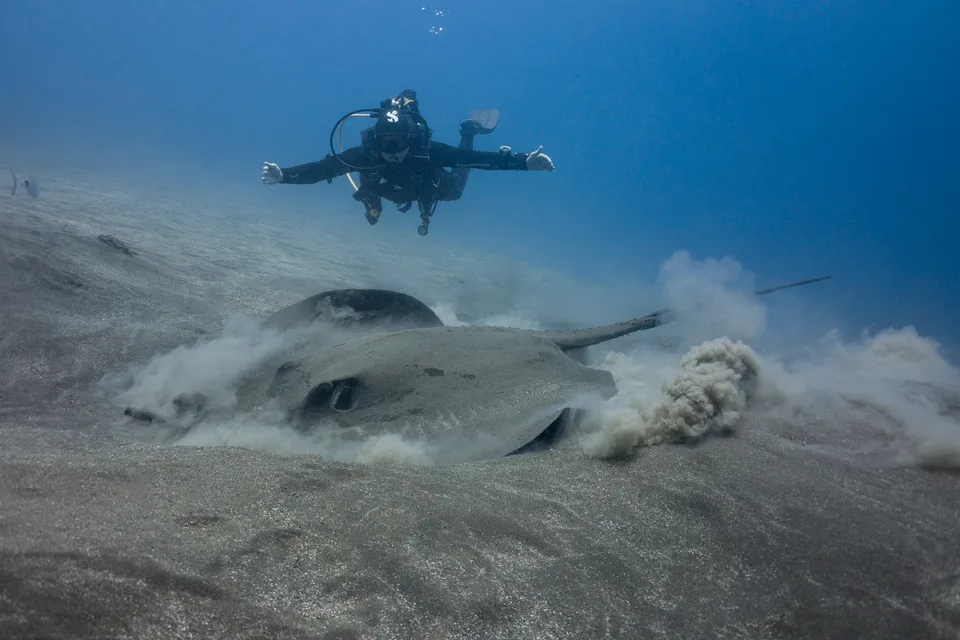
Benthic environments, often found on sandy or muddy bottoms.
Distribution
North-East Atlantic, from Norway to the Mediterranean.
Conservation status
Least Concern
Edibility
Edible, but not recommended as a routine choice because rays can be vulnerable to fishing pressure. Consume only legally and sustainably sourced catch; handle with great care because the tail spine is venomous.
Culinary quality / 5
3
Danger level
Caution
Usual observation depth
5–60 m
Behaviour
Generally solitary and living near the bottom. It often rests partially buried in the sand during the day and becomes more active at night to search for prey. Small seasonal aggregations may form.
Observation zones
Sand, mud, seagrass beds, shallow bays, lagoons, estuaries and reef edges with soft substrate.
Diet
Primarily benthic invertebrates, notably crustaceans, mollusks and marine worms; it also consumes small bottom-dwelling fish.
Reproduction
Ovoviviparous
Identification marks
Broad rhomboidal disc, generally plain grey-brown to olive-brown above and white below; long whip-like tail, usually longer than the disc, bearing one or more serrated venomous spines. Large individuals may exhibit scattered skin tubercles.
Similar species
May be confused with other stingrays of the Mediterranean and the Northeast Atlantic. The common stingray is generally plain and relatively smooth; species with visible blue spots, heavy marbling, or a distinctly rough and spiny disc are different. Identification of similar plain Dasyatis species may require careful examination.
Approach rules
Observe calmly from the side at least 2 to 3 m away. Do not touch, encircle, hover over, pursue, or disturb a buried ray. Avoid repeated flashes at close range and never feed it. Stay clear of the tail at all times.
Protection
Globally assessed as Least Concern on the IUCN Red List. It is not listed under CITES; local or regional management measures may nevertheless apply.