Indo-Pacific region, including the Red Sea and parts of the Indian and Pacific Oceans.
Conservation status
Least Concern
Edibility
Edible, but it is a small reef fish with limited culinary value and is not usually a target species. Reef fish may present ciguatera risk in some tropical areas; avoid consumption where this risk is known.
Culinary quality / 5
2
Danger level
Harmless
Usual observation depth
3–15 m
Behaviour
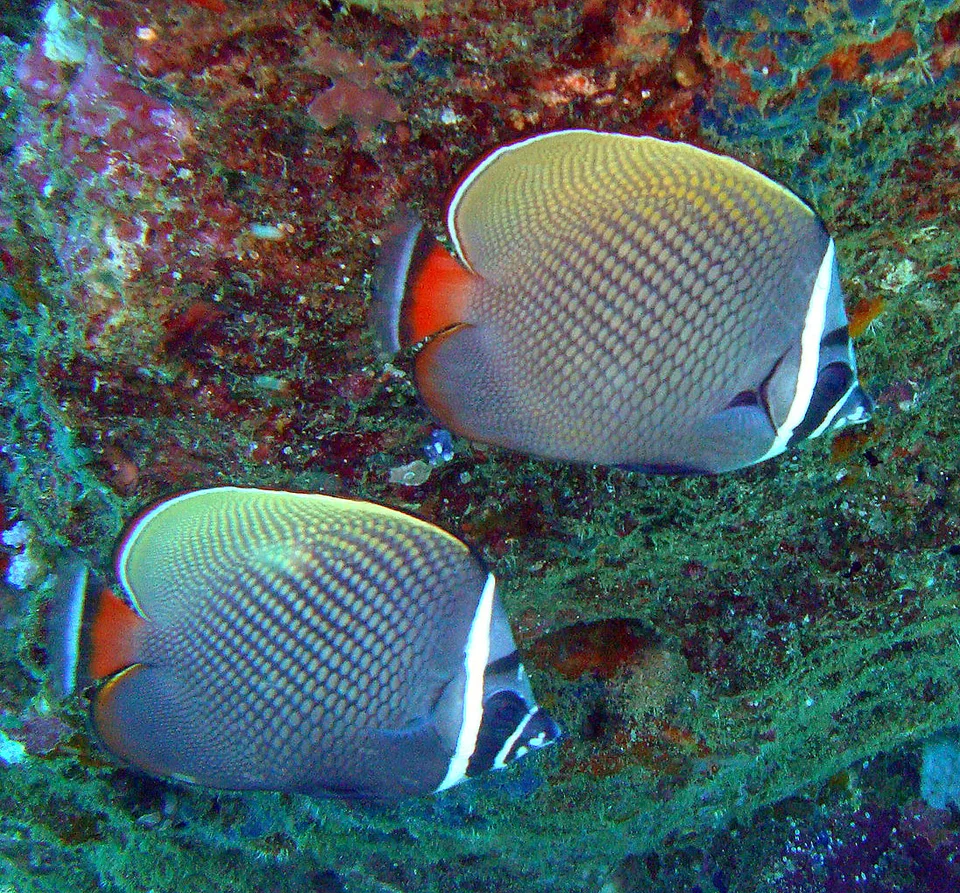
Observed alone, in pairs, or in small groups. Adults often form pairs and actively forage on coral-rich reef surfaces during the day; juveniles are more often solitary.
Observation zones
Shallow coral reef, lagoon, reef slope, pass and coral garden; generally near the bottom rather than in open water.
Diet
Feeds mainly on coral polyps and other benthic invertebrates, supplemented by algae and small crustaceans.
Reproduction
Oviparous
Identification marks
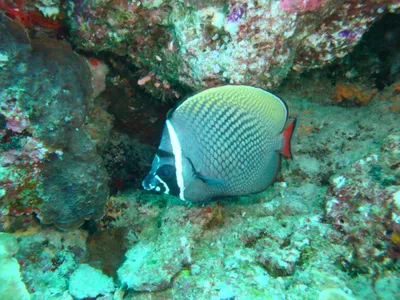
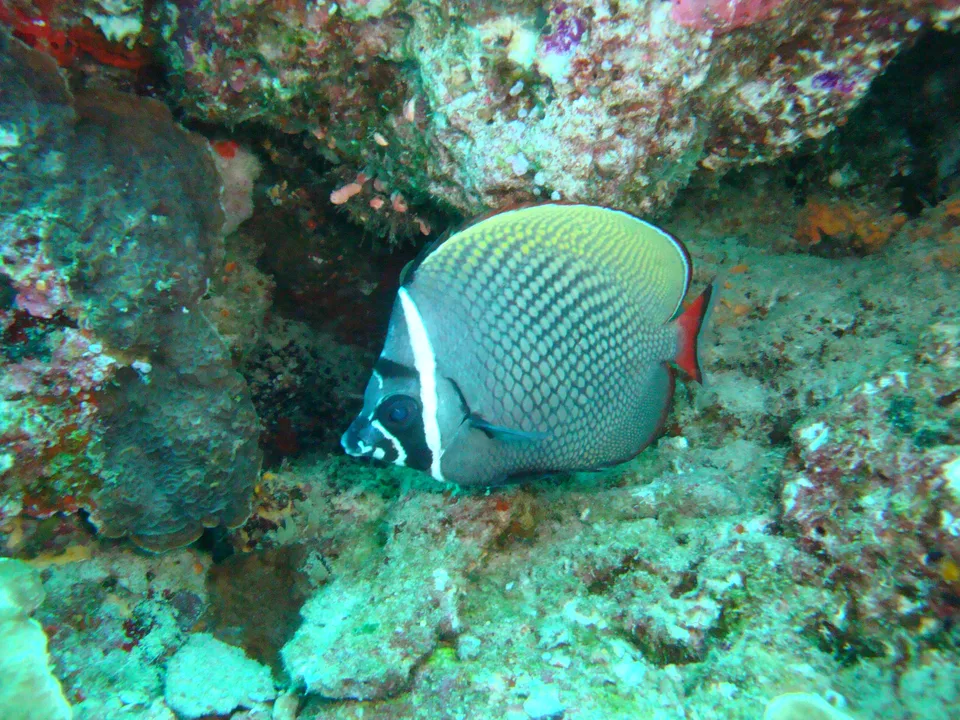
Tall, oval and laterally compressed butterflyfish. The yellowish to gray body bears fine, oblique dark lines, a dark band crossing the eye, and a broad, collar-shaped dark band on the rear of the body. The caudal fin is distinctly orange-red to red.
Similar species
May be confused with the raccoon butterflyfish (Chaetodon lunula) or the diagonal-banded butterflyfish (Chaetodon fasciatus). Chaetodon collare is distinguished by its broad dark posterior collar and highly visible orange-red tail; C. lunula has a more pronounced facial mask and crescent-shaped pattern, while C. fasciatus has neither a red tail nor a broad collar.
Approach rules
Approach slowly and parallel to the reef, keeping at least 2 to 3 m away whenever possible. Do not touch the corals or block its feeding path. Do not chase, feed, or handle the fish; use flash sparingly and never repeatedly at close range.
Protection
Globally classified as “Least Concern” on the IUCN Red List. It is not listed in the CITES appendices. Protection of coral reef habitats is important for the species.