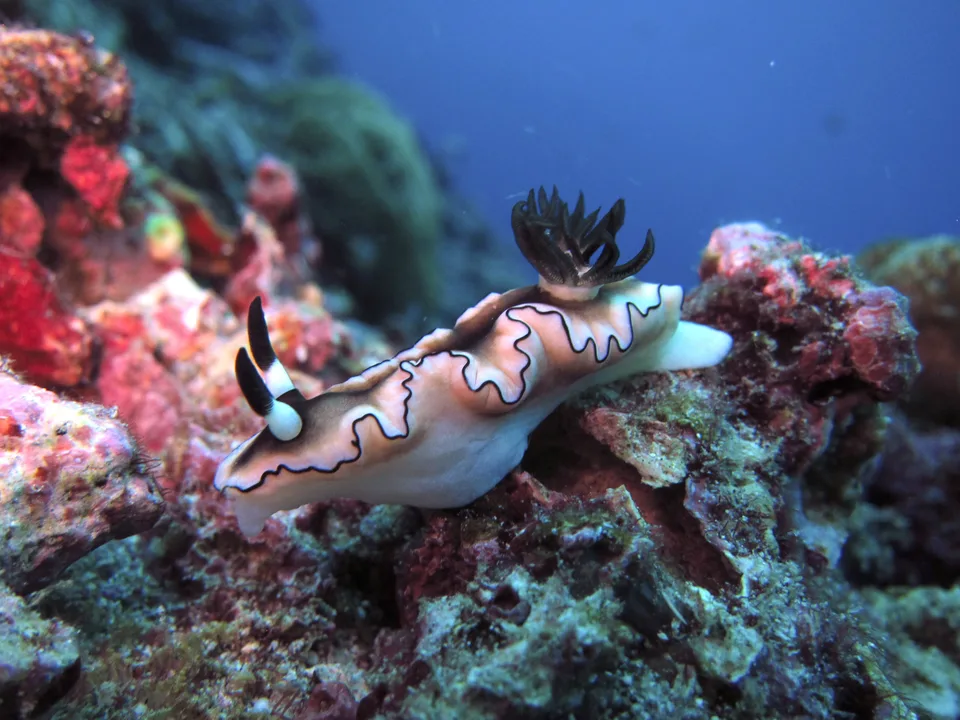
Not suitable for consumption. Like other chromodorid nudibranchs, it may retain defensive chemicals derived from sponges; do not collect or eat it.
Danger level
Caution
Usual observation depth
10–25 m
Behaviour
Slow and generally solitary nudibranch, active during the day. It crawls exposed on the reef substrate while searching for food and relies on chemical defenses and warning coloration.
Observation zones
Coral reef, reef slope, sponge-covered rock and rubble.
Diet
Specialized sponge consumer; the sponge species specifically consumed by this species are poorly documented.
Reproduction
Oviparous
Identification marks
Small dorid nudibranch with a white to cream mantle, bearing orange-yellow spots and a distinctly violet to purple mantle margin. The rhinophores and branchial plume are generally orange to yellowish.
Similar species
May be confused with similarly colored Goniobranchus species, notably G. geminus and G. tinctorius. Check the arrangement of the orange spots, the width and color of the mantle margin, the color of the rhinophores and gills, as well as the locality; a photograph alone does not always allow certain identification.
Approach rules
Observe without touching, handling, or moving the animal. Maintain controlled buoyancy and avoid any contact with the reef; keep approximately 1 m away whenever possible. Do not feed it. Avoid using flash or use the lowest effective setting, without repeated close-range exposures.
Protection
No CITES listing is known. The species has not undergone a global assessment by the IUCN; avoid collection and comply with regulations specific to protected areas.