Not generally used as food because of their small size and aquarium-fish value. Culinary quality is undocumented; avoid collecting wild fish.
Danger level
Harmless
Usual observation depth
1–30 m
Behaviour
Diurnal and territorial fish living in pairs or small social groups around a host anemone. They exhibit a size-based social hierarchy: the largest individual is the breeding female, followed by a breeding male; the smaller individuals do not reproduce. They can change sex, from male to female.
Observation zones
Coral reefs, reef slopes, sheltered lagoons, isolated reefs and shallow rocky areas where host anemones live.
Diet
Omnivores. Their diet includes zooplankton, small crustaceans, benthic algae, and food particles associated with the host anemone.
Reproduction
Oviparous
Identification marks
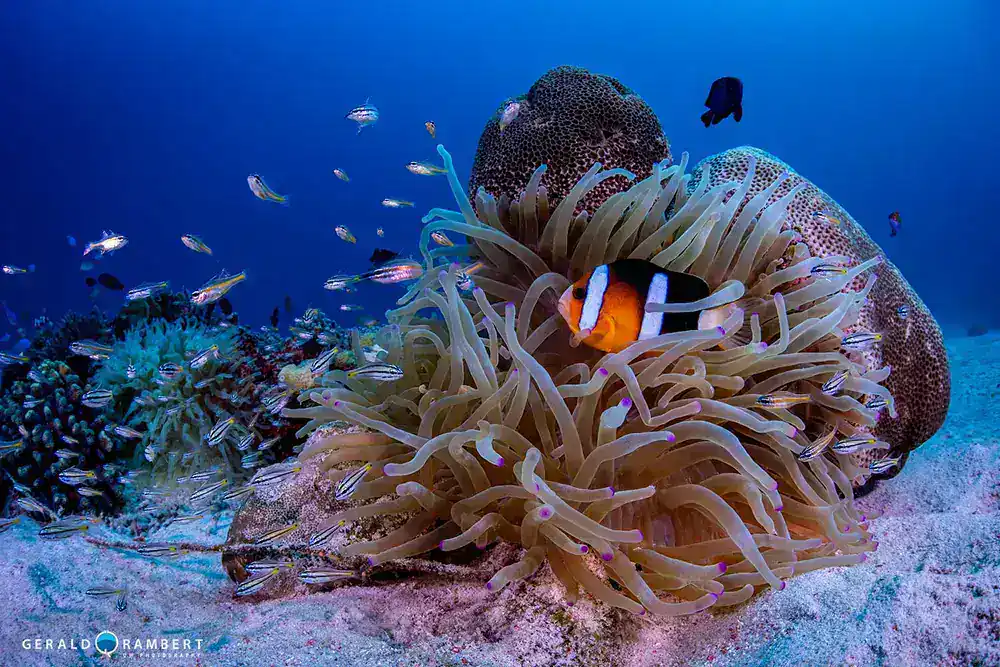
Small fish with deep bodies, related to damselfish, generally orange, red, brown, black or yellow, often marked with one to three light vertical bands. Most swim in an anemone or just above it.
Similar species
Individual species can be difficult to distinguish. Use geographic location, host anemone species, the number and width of body bands, fin coloration, and body shape. Juveniles may differ greatly from adults. Damselfish not associated with anemones may appear similar, but do not exhibit this constant association.
Approach rules
Approach slowly and stay away from the anemone. Do not touch, handle, feed, or chase the fish, and do not prevent them from returning to their shelter. Keep a respectful distance; do not use flash, or use minimal flash, especially near sensitive anemones.
Protection
Amphiprioninae is a subfamily and does not have a single global IUCN assessment. Conservation needs vary by species. Protect host anemones and reef habitat, and avoid collecting wild individuals for the aquarium trade.