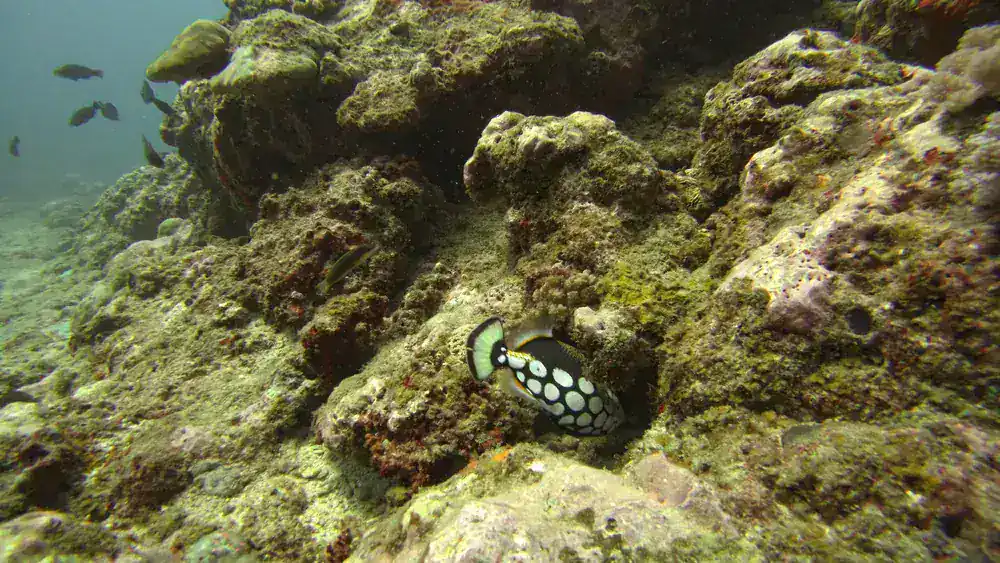
Coral reefs and rocky areas in tropical and subtropical waters.
Distribution
Widespread in the Indo-Pacific region.
Conservation status
Least Concern
Edibility
Edible and locally eaten, but large reef fish may carry ciguatera toxins in some areas. Avoid consumption where ciguatera is known or food-safety advice is uncertain.
Culinary quality / 5
3
Danger level
Caution
Usual observation depth
5–30 m
Behaviour
Generally solitary or observed in pairs. Diurnal and highly territorial near nesting sites; adults may aggressively defend their eggs, especially during the breeding season.
Observation zones
Coral reef, lagoon, reef slope, coral rubble and sandy patches of the reef.
Diet
Feeds mainly on benthic invertebrates, notably mollusks, crustaceans, sea urchins, and other hard-shelled animals, crushed by powerful teeth.
Reproduction
Oviparous
Identification marks
Large triggerfish with a deep body, black and covered with large white spots visible on the lower flanks and belly; yellow snout and lips; yellow markings on the back; first dorsal spine well-developed and protractile.
Similar species
Can mainly be confused with the titan triggerfish (Balistoides viridescens), generally larger, gray-green or yellowish, and lacking the large white spots characteristic of the clown triggerfish. Its pattern is otherwise distinctive among triggerfish.
Approach rules
Observe calmly and do not block its path. Stay well away from nests and back off in case of defensive behavior. Do not touch, feed, pursue, or use flash at close range; its bite can cause injury.
Protection
Listed as « Least Concern » by the IUCN globally. No CITES listing applies. Local reef fish management measures may exist; avoid disturbing spawning fish and favor sustainable harvesting practices.