Coral reefs and rocky substrates in tropical and subtropical waters.
Distribution
Found in the Indo-Pacific region, including the Red Sea and the Caribbean.
Conservation status
Least Concern
Edibility
Edible but very small and not normally collected for food. It is better left on reefs because of its ecological cleaning role.
Culinary quality / 5
2
Danger level
Harmless
Usual observation depth
3–30 m
Behaviour
Generally observed alone or in male-female pairs, often defending a small crevice. Mainly nocturnal, it may come out during the day to clean fish; its long white antennae signal its activity.
Ectoparasites, dead skin, mucus, small invertebrates, organic detritus and carrion. It also feeds as a scavenger when client fish are absent.
Reproduction
Oviparous
Identification marks
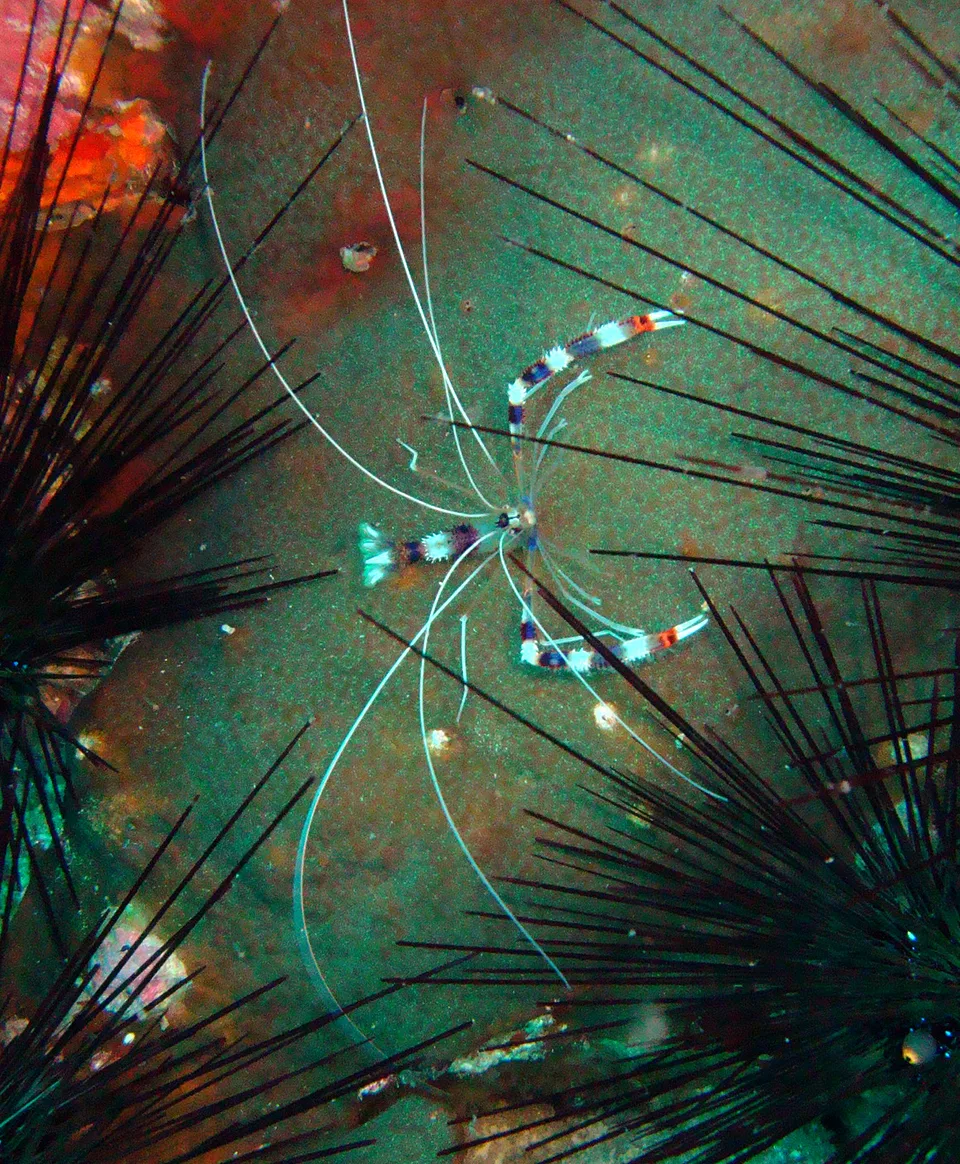
Highly recognizable shrimp, with a white to pale body crossed by red bands, exceptionally long white antennae, and a developed third pair of legs bearing large red-and-white pincers. The abdomen and legs often appear finely hairy.
Similar species
It can be confused with other cleaner shrimp, particularly species of the genus Lysmata. Stenopus hispidus is distinguished by its very large pincers on the third pair of legs, its red and white bands, and its much longer antennae. Lysmata have smaller pincers and a more slender body.
Approach rules
Approach slowly without blocking its retreat into the crevice. Keep a respectful distance, do not touch or handle it, and do not feed it. Use minimal lighting; avoid close and repeated flashes, especially at night.
Protection
No CITES listing is known. The species has not undergone a global assessment on the IUCN Red List; avoid unnecessary collection, particularly on reefs and at cleaning stations.