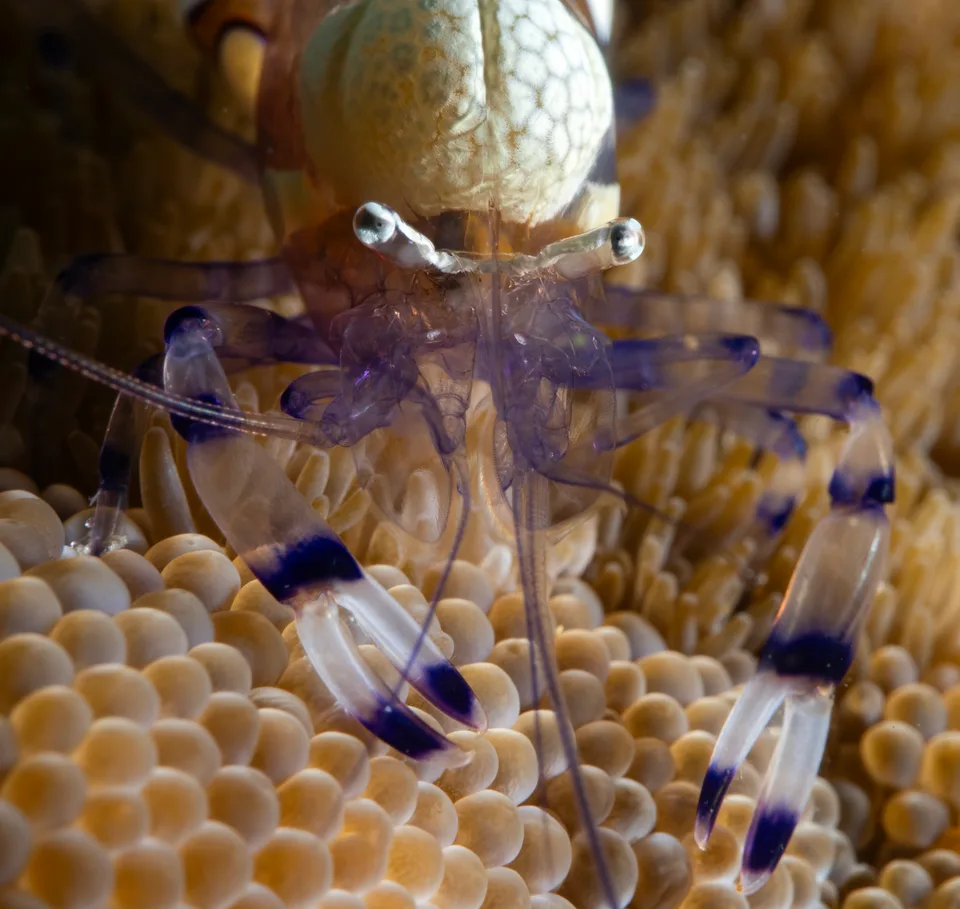
Typically found in coral reefs and associated with sea anemones.
Distribution
Found in the Indo-Pacific region.
Conservation status
Least Concern
Edibility
Not used as food because of its very small size; culinary quality is undocumented. Leave it in its anemone host.
Danger level
Harmless
Usual observation depth
3–20 m
Behaviour
Usually lives alone, in pairs or in small groups among the tentacles of a host anemone. Mainly active during the day, it can clean small fish by removing mucus, debris and ectoparasites.
Omnivorous scavenger and cleaner. Feeds on planktonic particles, organic debris, mucus, and occasionally ectoparasites removed from fish.
Reproduction
Oviparous
Identification marks
Small, largely transparent shrimp, with scattered white dots or spots, clearly visible violet-blue to purple markings on the legs and joints, as well as white markings on the tail fan. It is often observed on or in a large sea anemone.
Similar species
Often confused with other anemone shrimp, notably Ancylomenes longicarpus and related species of Periclimenes. Identification may require close examination of body markings and appendage proportions; A. longicarpus generally has a more elongated carpus on the second walking legs.
Approach rules
Approach slowly without touching the anemone or shrimp. Maintain good buoyancy and avoid placing hands, fins, or equipment near the host. Do not feed it. Avoid using flash at very close range; if possible, use limited, diffused light.
Protection
Globally assessed as Least Concern on the IUCN Red List. No CITES listing applies. Avoid collection and disturbance, particularly of its host anemone.