Shallow tropical coastal waters, especially coral reefs, reef flats, lagoons, sandy areas and seagrass beds. It often rests beneath coral ledges or in crevices during the day.
Distribution
Widespread in the tropical Indo-Pacific, from the Red Sea and East African coast eastward to the western Pacific, including southern Japan, northern Australia and many Indonesian and Pacific islands.
Conservation status
Least Concern
Edibility
Edible in principle but not commonly regarded as a food fish. Consumption is discouraged because it is a small reef ray with limited, locally variable fisheries information; avoid eating specimens from reefs where contamination or ciguatera risk is a concern.
Culinary quality / 5
2
Danger level
Caution
Usual observation depth
1–20 m
Lifespan (years)
0
Behaviour
Usually solitary or encountered in small groups. Primarily active at night, when it forages over sand and reef areas; by day it commonly shelters under ledges, in caves or within reef crevices. It may bury itself partly in sand.
Mainly benthic invertebrates, especially worms, small crustaceans and molluscs; it may also take small fishes.
Reproduction
Ovoviviparous
Identification marks
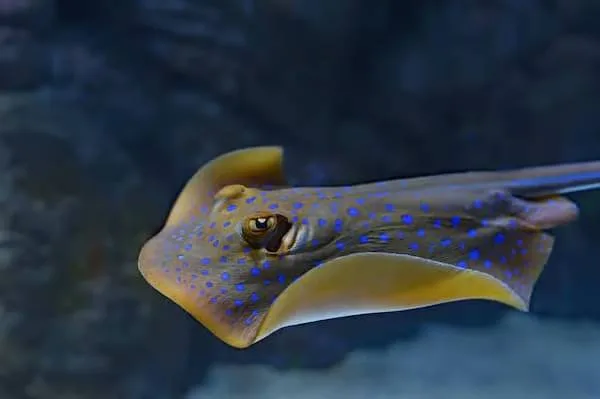
Small, oval ray with a yellowish-brown to olive disc covered in vivid electric-blue spots. The tail is relatively short and bears bright blue longitudinal stripes, typically with two venomous spines near its base. The underside is pale.
Similar species
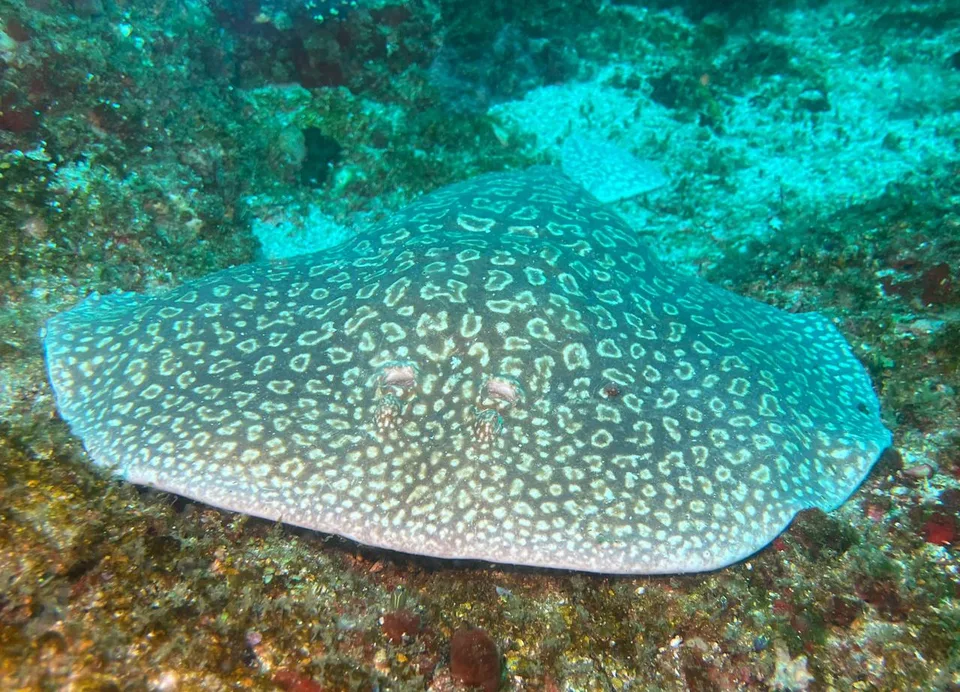
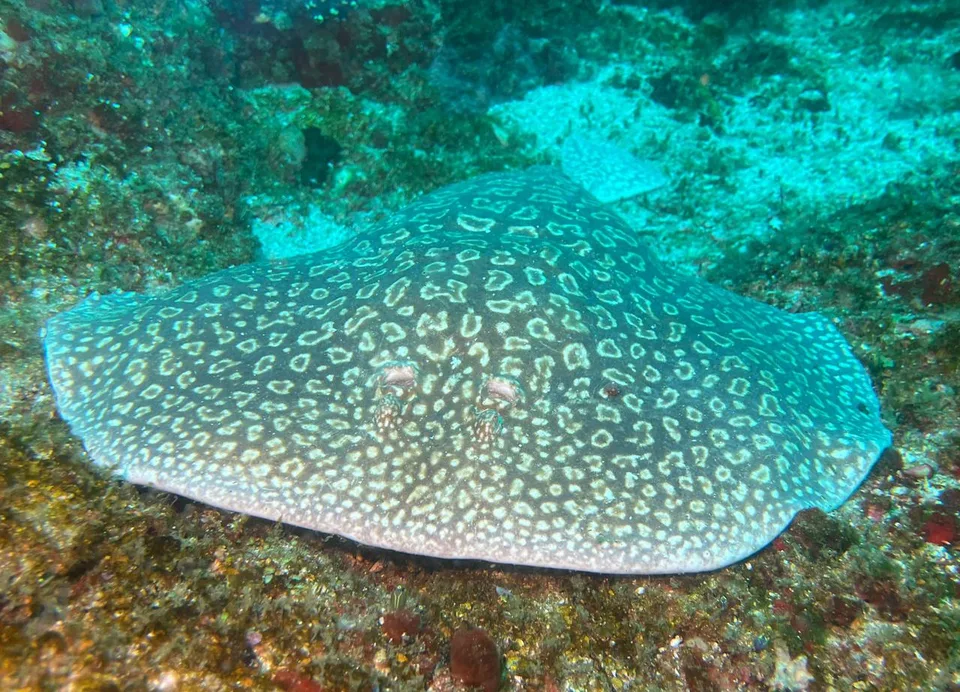
It can be confused with blue-spotted maskrays (Neotrygon species), which usually have a more rounded disc and lack the distinctive blue-striped tail. The blotched fantail ray, Taeniura meyeni, grows much larger and has dark blotches rather than numerous small bright-blue spots.
Approach rules
Observe calmly from at least 2 m away. Do not touch, chase, corner, handle or stand near it, especially if it is resting on sand; its tail spines can inflict painful defensive wounds. Keep its escape route open, do not feed it, and avoid direct or repeated flash photography.
Protection
Globally assessed as Least Concern (LC) by the IUCN. It is not listed in the CITES Appendices. Avoid collection or disturbance, and follow marine protected area rules and responsible wildlife-viewing practices where applicable.