Not a customary food species and culinary use is poorly documented. Consumption is not recommended; avoid collecting wild sea stars, especially where populations may be affected by the aquarium-curio trade.
Danger level
Harmless
Usual observation depth
1–20 m
Behaviour
Slow-moving benthic starfish, generally observed alone but sometimes in loose groups. It is active while grazing and can regenerate lost arms; detached arms may contribute to asexual reproduction under certain circumstances.
Primarily grazes on biofilm, microalgae, detritus and microscopic organisms present on hard surfaces; it may also consume small sessile organisms.
Reproduction
Oviparous
Identification marks
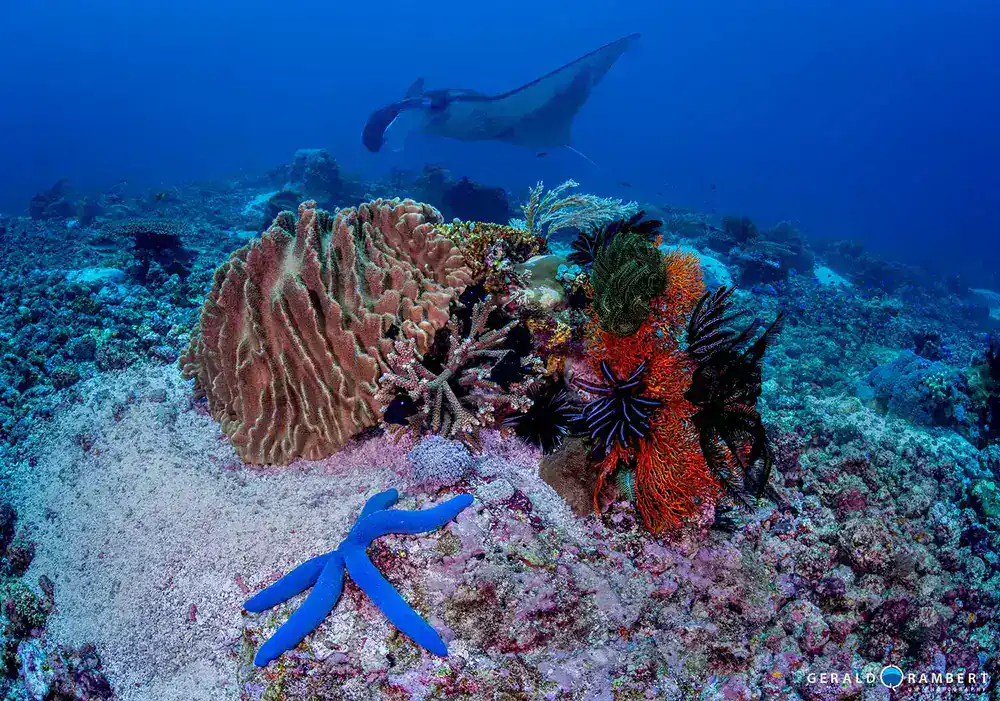
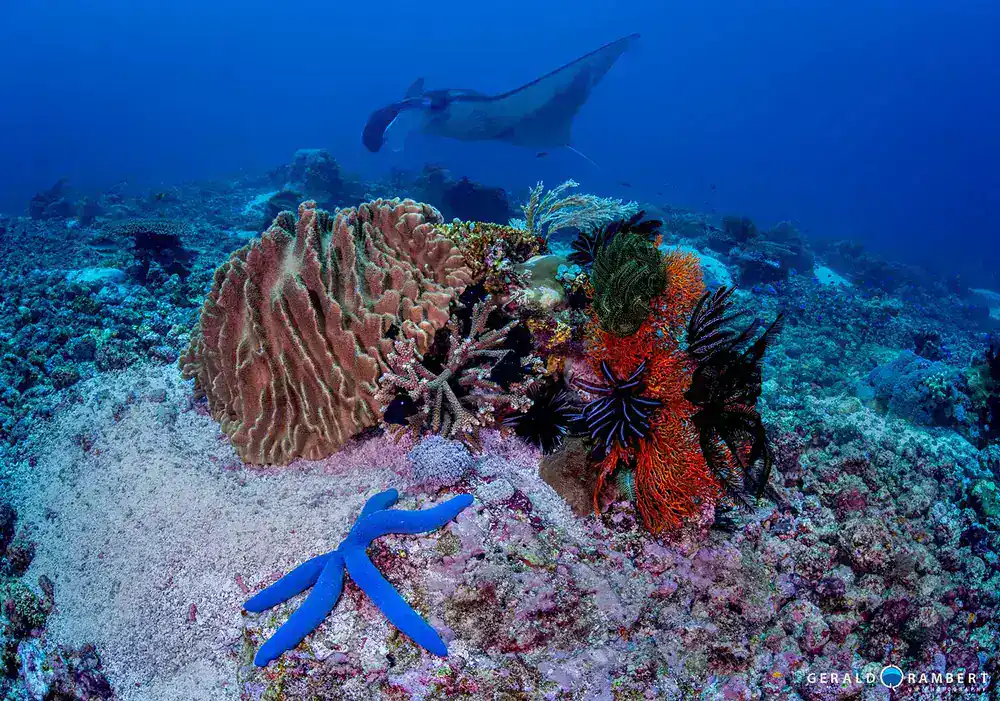
Usually has five long, rounded cylindrical arms and a small central disc. The upper surface usually appears smooth and is uniformly bright blue, turquoise, blue-green or sometimes purple; adults can reach approximately 30 cm across.
Similar species
It can be confused with other sea stars of the genus Linckia, particularly Linckia multifora. L. multifora is usually more mottled or variably colored and often has an irregular number of arms, whereas L. laevigata typically has five long arms and a more uniform blue coloration.
Approach rules
Observe it without touching, lifting or moving it. Maintain neutral buoyancy, avoid resuspending sediments and do not feed it. Prefer natural light; avoid close and prolonged flashes, especially if repeated.
Protection
IUCN Red List: Least Concern (LC). The species is not listed under CITES. Local populations may be vulnerable to intensive collection for the aquarium and souvenir trades; avoid collecting and comply with applicable site regulations.