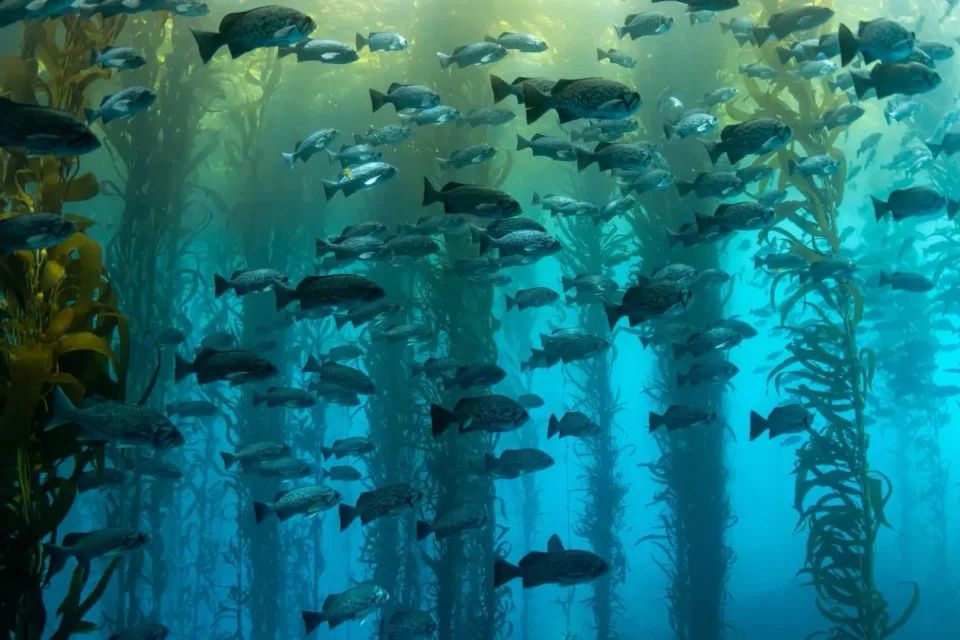
Edible, but it is not generally an important food fish and has limited culinary use. Follow local seafood-health advice.
Culinary quality / 5
2
Danger level
Harmless
Usual observation depth
3–30 m
Behaviour
A diurnal and social damselfish. It often forms schools above reefs and kelp, hovering in the water column to capture plankton; adults may defend nesting sites during breeding.
Observation zones
Rocky reef, kelp forest, reef drop-off, rocky pinnacles and adjacent blue water.
Diet
Mainly zooplankton, notably small crustaceans and fish larvae; it can also consume benthic algae and other small reef organisms.
Reproduction
Oviparous
Identification marks
Body laterally compressed, dark blue-black to dark gray; often observed in highly visible schools. Fine dark spots on the fins and scales give it a slightly speckled appearance. Juveniles are generally a brighter blue.
Similar species
May be confused with other eastern Pacific Chromis. Chromis limbaughi, blue and yellow, has a much brighter blue body and a yellow tail, whereas adult smiths are mainly dark blue-black or gray.
Approach rules
Approach slowly and, if possible, keep at least approximately 2 m away. Do not pursue schools and do not disturb potential nesting sites. Avoid repeated flashes at close range and never feed the fish.
Protection
IUCN: Least Concern (LC). Not listed in CITES; no general international trade restriction is known.