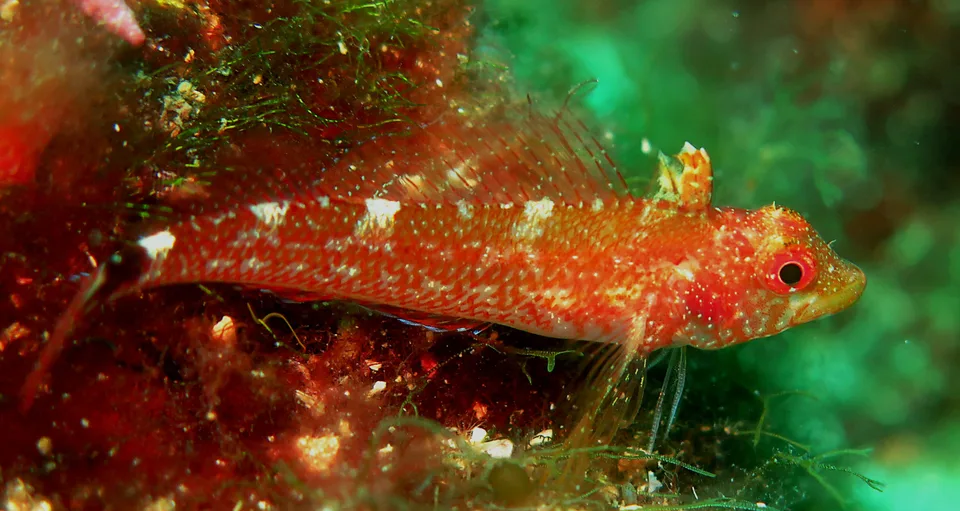
Shallow rocky coastal seabeds with algae, boulders, crevices and seagrass margins.
Distribution
Northeastern Atlantic and Mediterranean Sea, from Portugal and northwestern Africa eastward through the Mediterranean.
Conservation status
Least Concern
Edibility
Edible but very small and of no significant culinary or commercial value; it is best left undisturbed.
Culinary quality / 5
1
Danger level
Harmless
Usual observation depth
1–15 m
Lifespan (years)
0
Behaviour
Usually solitary and bottom-dwelling. It rests or darts among algae and crevices, feeding by day; males may guard eggs during the breeding season.
Observation zones
Rocky reef, algae-covered boulders, tide pools, crevices and seagrass edges.
Diet
Small benthic invertebrates, especially tiny crustaceans and other zooplankton or animals picked from the substrate.
Reproduction
Oviparous
Identification marks
A very small, elongate triplefin with three separate dorsal fins. It is mottled brown to reddish for camouflage and typically shows a distinctly dark to black caudal fin; males develop stronger breeding coloration.
Similar species
Can be confused with other Mediterranean Tripterygion species, notably T. delaisi and T. tripteronotum. Confirm identification from the dark caudal fin together with head and body pattern; breeding males can differ greatly in colour, so photographs and regional identification guides are useful.
Approach rules
Approach slowly and stay clear of its shelter; do not touch rocks, algae or egg sites. Avoid flash at close range and never feed it.
Protection
Assessed globally as Least Concern on the IUCN Red List. No CITES listing is known; protect coastal habitat and avoid unnecessary collection.