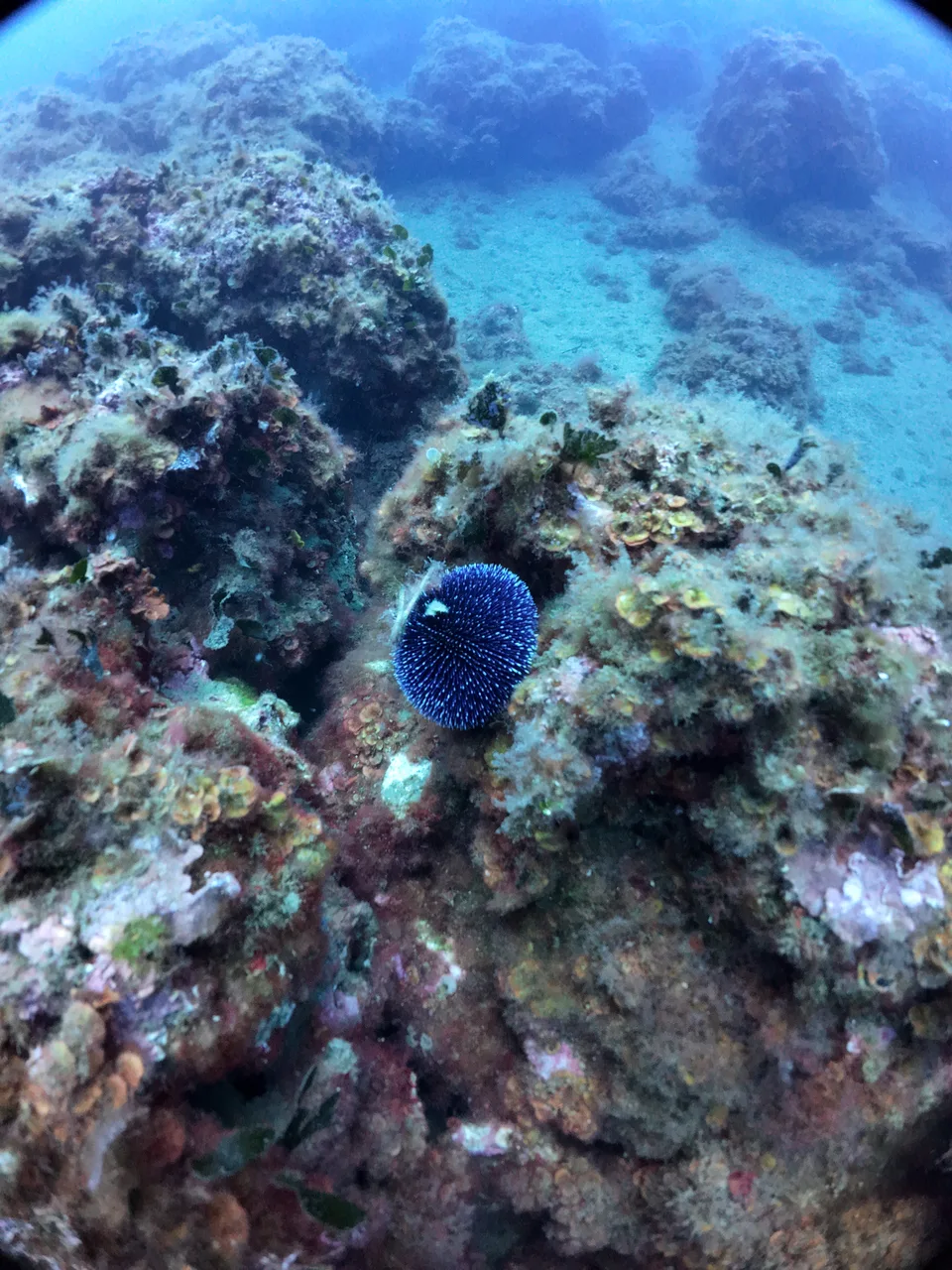
The roe is edible, but this species is generally less valued for consumption than some other sea urchins. Consume only when correctly identified and obtained from a safe, clean source; avoid raw consumption where food-safety conditions are uncertain.
Culinary quality / 5
2
Danger level
Caution
Usual observation depth
?–30 m
Behaviour
Mostly nocturnal grazer. During the day, it often shelters in crevices, under rocks, or in shaded areas. Individuals may be solitary or form dense local aggregations when the substrate and food are favorable.
Observation zones
Rocky reefs, boulder fields, reef walls, tide pools and crevices; mostly on hard substrate rather than open sand or in the water column.
Diet
Primarily grazes on benthic algae and microalgal films. It may also incidentally consume encrusting organisms and small sessile invertebrates while grazing.
Reproduction
Oviparous
Identification marks
Black to very dark purple sea urchin, with a relatively flattened rounded test and numerous long, thin, pointed spines. The general coloration is usually uniform and much darker than that of the common Mediterranean sea urchin.
Similar species
Often confused with Paracentrotus lividus, the common Mediterranean sea urchin. P. lividus is generally violet, brown, greenish or reddish rather than uniformly black, and often has shorter, thicker spines. Diadema species have much longer, thinner spines.
Approach rules
Observe without touching or handling. Control your buoyancy to avoid the spines and surrounding reef; do not feed, collect, or move individuals. Avoid placing your equipment on the bottom. Limit the use of flash near sheltered individuals.
Protection
Globally classified as “Least Concern” on the IUCN Red List. No CITES listing is known. Protect local reef habitats and avoid unnecessary collection; local collection regulations may apply.