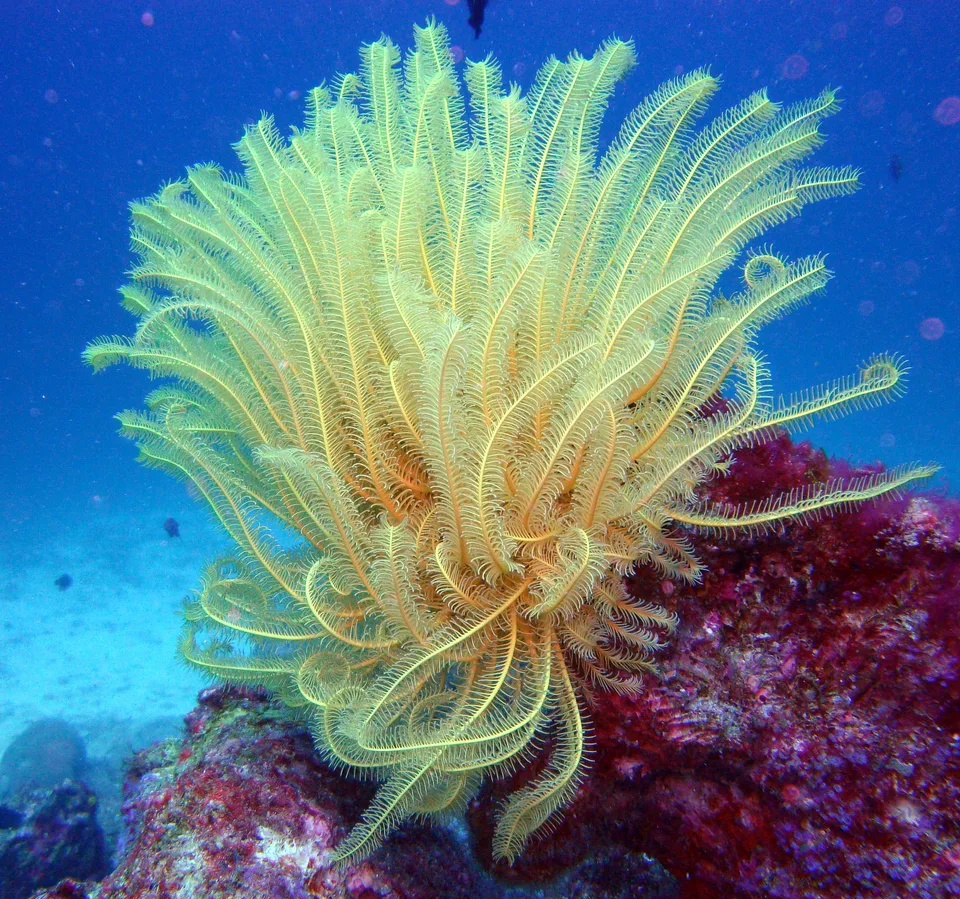
Found in shallow waters, often on coral reefs or rocky substrates.
Distribution
Widespread in tropical and subtropical waters.
Conservation status
Least Concern
Edibility
Not intended for consumption; culinary quality is undocumented. Do not collect reef animals.
Danger level
Harmless
Usual observation depth
3–20 m
Behaviour
Usually seen alone or in small scattered groups. It perches high up, spreads its feathery arms into the current to filter food, and can crawl slowly or swim short distances.
Observation zones
Reef, especially reef crests, shallow slopes, and current-exposed coral heads.
Diet
Plankton, suspended organic particles, and tiny organisms trapped by the pinnules on its arms.
Reproduction
Oviparous
Identification marks
A stalkless crinoid with numerous branched, feathery arms and curled cirri used for gripping. Colour is highly variable, often brown, yellow, red, or mottled.
Similar species
It can be confused with other Indo-Pacific feather stars, notably species of Comaster and Anneissia. Colour alone is unreliable; species-level identification requires examination of arm, cirrus, and plate structure.
Approach rules
Approach slowly without touching, moving, or collecting the animal or its support. Maintain good buoyancy control; avoid close or repeated flash and do not feed it.
Protection
No known CITES listing. The global IUCN status has not been evaluated; follow reef-protection measures and rules applicable in marine protected areas.