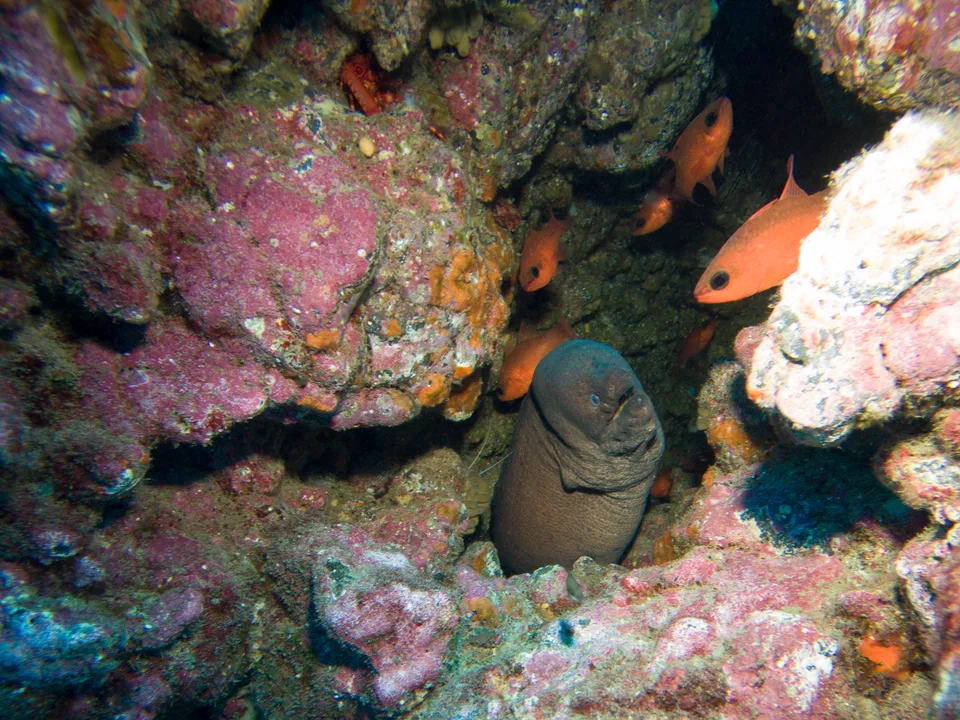
Found in rocky and coral reefs, often hiding in crevices.
Distribution
Widespread in the tropical and subtropical waters of the Atlantic Ocean.
Conservation status
Least Concern
Edibility
Edible, but morays may accumulate ciguatera toxins in some island regions. Consumption is therefore best avoided where ciguatera is known or fish-safety advice is uncertain.
Culinary quality / 5
3
Danger level
Caution
Usual observation depth
5–50 m
Behaviour
Generally solitary and reclusive. Mainly nocturnal, it remains in a crevice during the day and emerges to hunt, while defending its shelter if disturbed at close range.
Predator; it feeds primarily on fish, crustaceans and cephalopods, particularly during its nocturnal foraging.
Reproduction
Oviparous
Identification marks
Robust moray eel with a long, laterally compressed body, generally very dark brown to almost black. Pale spots may be present, especially toward the rear of the body; the head has the typical profile of a large-jawed moray eel.
Similar species
It can be confused with the Mediterranean moray (Muraena helena), whose marbled or reticulated yellow-brown coloration is more conspicuous than the generally dark and uniform coloration of M. augusti. The fangtooth moray (Enchelycore anatina) has a distinctly yellow head and clearly visible curved teeth.
Approach rules
Observe calmly without blocking the entrance to its refuge. Keep your hands, cameras, and dangling equipment away from its mouth; do not touch it, feed it, or try to make it come out of its hole. Avoid using flash at very close range and move back if it opens its jaws or advances.
Protection
Classified as “Least Concern” globally on the IUCN Red List. It is not listed under CITES. Avoid disturbance, collection, and habitat degradation, and comply with protected-area regulations where applicable.