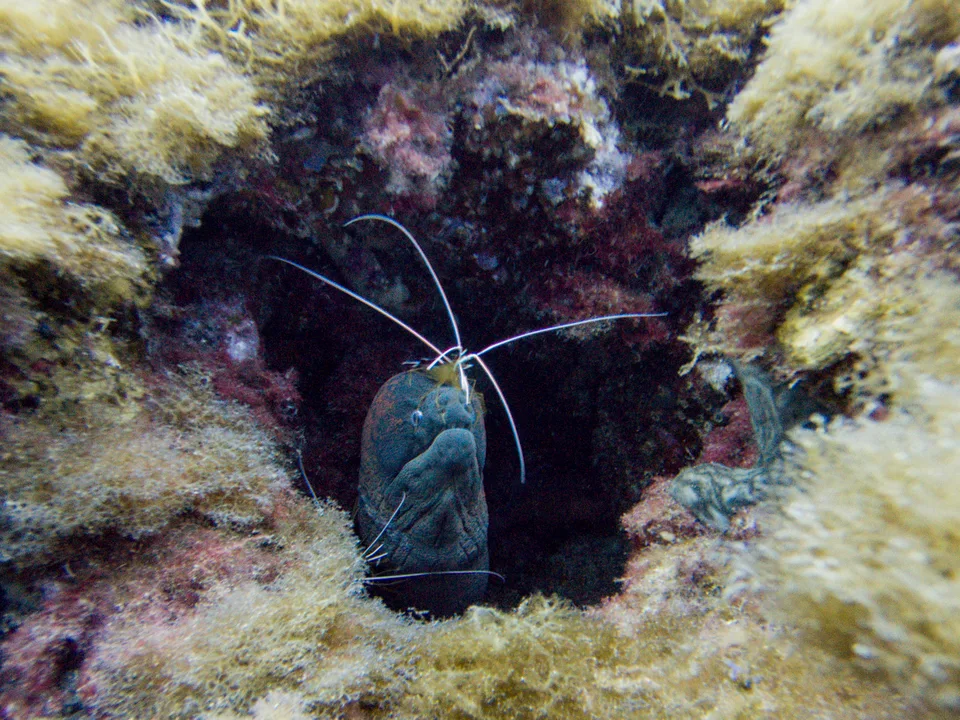
Potentially edible like other small shrimps, but it is very small and primarily known as an ornamental cleaner shrimp; culinary use is poorly documented and it should not be collected from reefs.
Danger level
Harmless
Usual observation depth
5–30 m
Behaviour
Usually lives in pairs or small groups at fixed cleaning stations. It waves its long white antennae to signal its service and removes parasites, mucus, and debris from visiting fish. Mainly active at dusk and at night, but often visible during the day in shelters.
Ectoparasites, dead tissue, mucus, organic detritus and small food particles obtained while cleaning fish; it may also be a scavenger.
Reproduction
Oviparous
Identification marks
Small translucent to reddish shrimp, with a broad, highly visible white stripe along the back and abdomen, long white antennae, and an elongated body. It is often found facing outward from a crevice at a cleaning station.
Similar species
May be confused with other cleaner shrimp of the genus Lysmata. L. amboinensis, Indo-Pacific, is very similar but does not occur in the Atlantic. In the northeast Atlantic and the Mediterranean, L. seticaudata may be similar; location, colour pattern and sometimes specialised examination are necessary for reliable identification.
Approach rules
Approach slowly and remain outside the crevice; do not block the entrance or disturb visiting fish. Do not touch, handle, or collect the shrimp. Do not feed it and avoid using flash at close range.
Protection
Not listed under CITES. A global IUCN assessment is not currently established for this species; avoid unnecessary collection, especially at reef cleaning stations, and comply with the regulations applicable to the site and country.