Not regarded as a food fish. Its culinary use is undocumented; it is a small ornamental reef species and should not be collected for consumption.
Danger level
Harmless
Usual observation depth
3–15 m
Behaviour
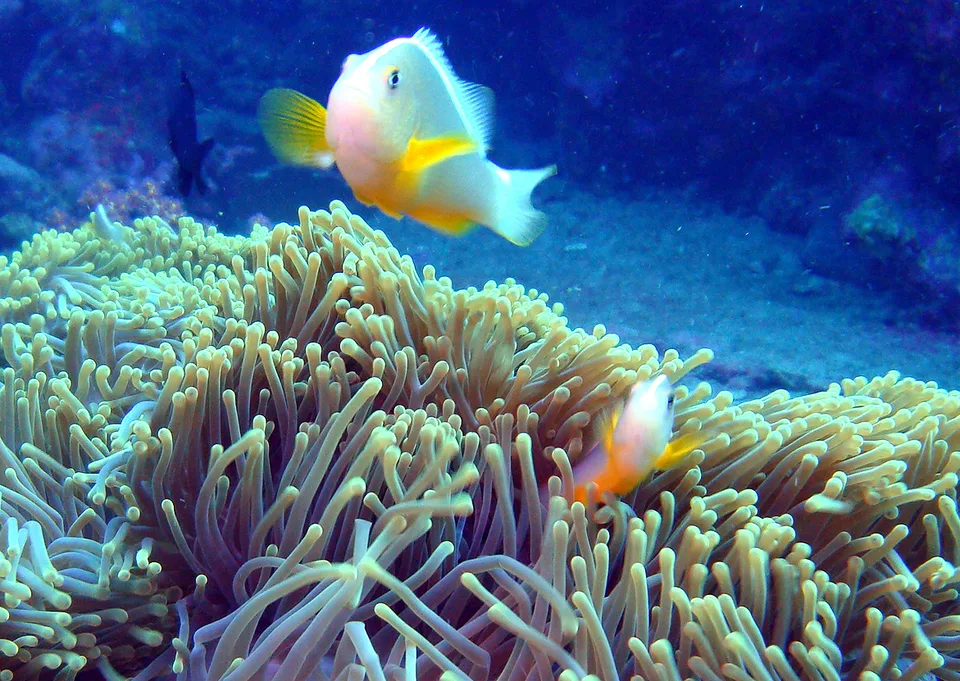
Diurnal and strongly associated with a host anemone. Generally observed as a breeding pair or in a small social group with a size-based hierarchy; it defends its anemone and the adjacent territory.
Observation zones
Shallow reef, lagoon, sheltered reef slope and coral bommie areas harboring host anemones.
Diet
Omnivore feeding on plankton. Consumes zooplankton, small crustaceans, benthic algae and small invertebrates; may also eat food particles associated with its anemone.
Reproduction
Oviparous
Identification marks
Small pinkish to orange clownfish, bearing a thin white stripe along the dorsal midline, from the snout to the base of the tail. It does not have the broad vertical white bars typical of many clownfish.
Similar species
Often confused with other skunk clownfish. Amphiprion sandaracinos is generally more uniformly yellow-orange, whereas A. nigripes has distinctly dark pelvic and anal fins. Amphiprion pacificus is similar, but lives in the central and western Pacific rather than the Indian Ocean.
Approach rules
Approach slowly and remain at least 1 to 2 m away if possible. Do not touch, block, or disturb the host anemone; do not feed the fish. Avoid using flash, or use it minimally, especially during repeated shots, and move away if the fish exhibits persistent defensive behavior.
Protection
Assessed as “Least Concern” on the IUCN Red List. It is not listed in the CITES Appendices. Avoid collecting wild individuals and damaging host anemones or coral habitat.